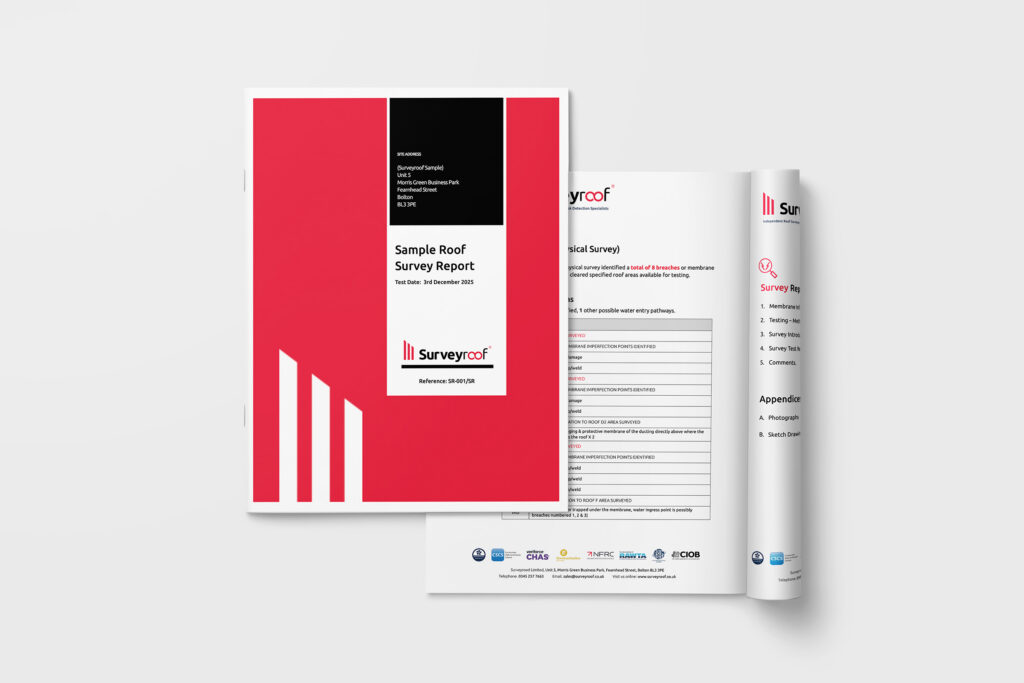
Membrane Condition Roof Survey, Hempstead
Project Overview
Surveyroof were instructed to carry out an independent membrane condition roof survey at Mosaic House in Hemel Hempstead. The waterproofing system was Hertalan EPDM laid directly onto a concrete substrate/deck, covering an area of approximately 90 m².
The survey was completed in quick time for the client, with the report issued the same evening, allowing remedial works to be actioned without delaying the wider programme.
Survey Method
A combination of wet testing (Earth Leakage Leak Detection) and dry testing (Holiday Detector testing) was utilised throughout the survey. This ensured testing could continue efficiently despite fluctuations in weather conditions on site.
Surveyroof technicians are fully trained in both wet and dry electronic leak detection methods, and all survey vehicles are equipped with both testing units. This allows our teams to adapt instantly to changing site conditions without compromising survey quality or coverage.
Scope of Works
Our roof survey included:
- Membrane condition survey to the EPDM waterproofing area
- Scan-Map wet testing technique suitable for conductive and semi-conductive EPDM
- Physical inspection using probing to details where appropriate
- Full visual inspection of the roof area surveyed, including details and interfaces
- Clear reporting so repairs could be completed prior to reinstating insulation and paving
Surveyroof always includes physical probing and close-detail checking as part of our membrane condition surveys where appropriate. It’s labour intensive, but it’s a critical part of the process, as electronic methods can have limitations around laps, terminations, and complex details.
Key Findings
Traditional wet and dry electronic leak detection methods are not suitable for EPDM in many cases due to the material containing carbon black, which makes it conductive.
In this instance, we were able to apply our Scan-Map wet testing technique, which allows testing of conductive and semi-conductive EPDM waterproofing when installed over:
- A conductive substrate (such as concrete)
- Foil-faced insulation, or
- A suitable conductive medium (such as a primer or mesh)
Once the paving and insulation had been removed, we squeegeed excess water from the test area and carried out the Scan-Map survey. This enabled us to identify defects within the EPDM membrane which required repair to restore the waterproofing integrity prior to reinstatement of the insulation and paving.
Why This Roof Survey Was Essential
When waterproofing sits beneath insulation and paving, defects can remain hidden for long periods and become expensive and disruptive to investigate. Identifying issues before reinstatement is essential, because once the build-up is back in place, access becomes significantly more difficult and costly.
- Provides confidence that the waterproofing is performing as intended
- Prevents trapped moisture and repeat disruption
- Allows repairs to be completed at the correct stage of the programme
- Reduces the risk of rework after insulation and paving are reinstated
Outcome for the Client
The independent survey enabled:
- Confirmation of waterproofing condition prior to reinstatement works
- Accurate identification of defects within conductive EPDM using Scan-Map testing
- Targeted repairs to restore the membrane’s integrity
- Reduced programme risk by issuing the report the same evening
- Confidence that insulation and paving could be reinstated over a repaired membrane
This project demonstrates Surveyroof’s ability to select the correct test method for the membrane type on site, and to support electronic testing with physical probing and detailed visual inspection, ensuring defects are not missed at the most critical roof details.